Skip to content
LOUDCROWD
Menu

Shopify & WooCommerce · Recovery, then growth

Send us one URL. In two working days you’ll know what broke your organic revenue.

We fix ecommerce search revenue on Shopify and WooCommerce, for stores doing £500k a year and up. The same six people who find the fault build the fix into your store, so nothing waits in a queue behind your developer.

Not a form, not a chatbot, and no call in the diary before you’ve seen it.

  • David Johnson, Founder
  • Emma Morris, SEO specialist
  • Oliver Davies, SEO specialist
  • Evie Wiseman, SEO specialist
  • Manivannan M., SEO specialist

David or Oliver records it himself, from our office in Doncaster. Reply within one working day.

Four of the LoudCrowd team around one screen, reviewing a client’s Search Console.

The two commonest faults

Do any of these sound like your store?

After a replatform

What you see
You moved to Shopify, the store looks better than it ever has, and organic orders are down somewhere between a third and a half. They have not come back on their own. Paid is holding the line and your agency says it takes time.
What it usually is
Almost always the redirects. The old URLs were mapped in bulk to the nearest collection, or not mapped at all, so every product Google had ranked now answers with a category page or a 404. Where a map does exist it usually runs two and three hops deep, and each hop leaks whatever authority survived the last one.
What we do
We rebuild the map from your old URL export — one hop, product to product, no chains. Then the collection pages that lost their copy in the move, then every internal link still pointing at a URL that no longer exists.
Migration recovery

Nothing broke and you’re still behind

What you see
No migration, no penalty, no drop to point at. You simply don’t rank for the searches that would sell your products, and the competitor who does isn’t obviously better than you at anything else.
What it usually is
Usually crawl waste and thin category pages, together. Your filters generate thousands of near-identical URLs, so Google spends its budget on colour-and-size combinations instead of the dozen collection pages that earn money — and those dozen pages carry forty words each.
What we do
We take the filtered URLs out of the crawl, then write and build the collection and buying-guide pages for the searches your category actually makes. That is the half of the monthly work that adds ground rather than defending it.
Ecommerce SEO

Something else?

Fourteen faults we see repeatedly, each with the check you can run on your own store before you speak to anybody.

All the symptoms

One result, in full

Reclaimed Brick: revenue from Google up 80% in the 12 months to March 2026.

12 months to March 2026 Organic search

Organic revenue

1.8 × up 80%

year on year

Window

12 months

to March 2026

Client

Reclaimed Brick

Shopify Shopify · Sheffield

200 100 0 index · 100 = their average month, the year before Apr Jun Aug Oct Dec Feb
Since we took over The year before

Read from their own GA4 and Shopify admin. Published case study.

They replatformed to Shopify in early 2025 and lost the category pages the business ran on. Fourteen hundred product URLs had been pointed at a single collection, and the collections that survived the move had lost the material-specific copy their buyers search for.

We remapped every product URL to its own product, rewrote the material collections around the lot-specific questions their buyers actually ask, and fixed template speed on the pages already taking traffic. Fourteen weeks, one quote, agreed before anything started.

Revenue from organic search finished 80% up on the twelve months before. It is their largest channel by orders now, and they have been on monthly work with us since the recovery closed.

Read the full write-up
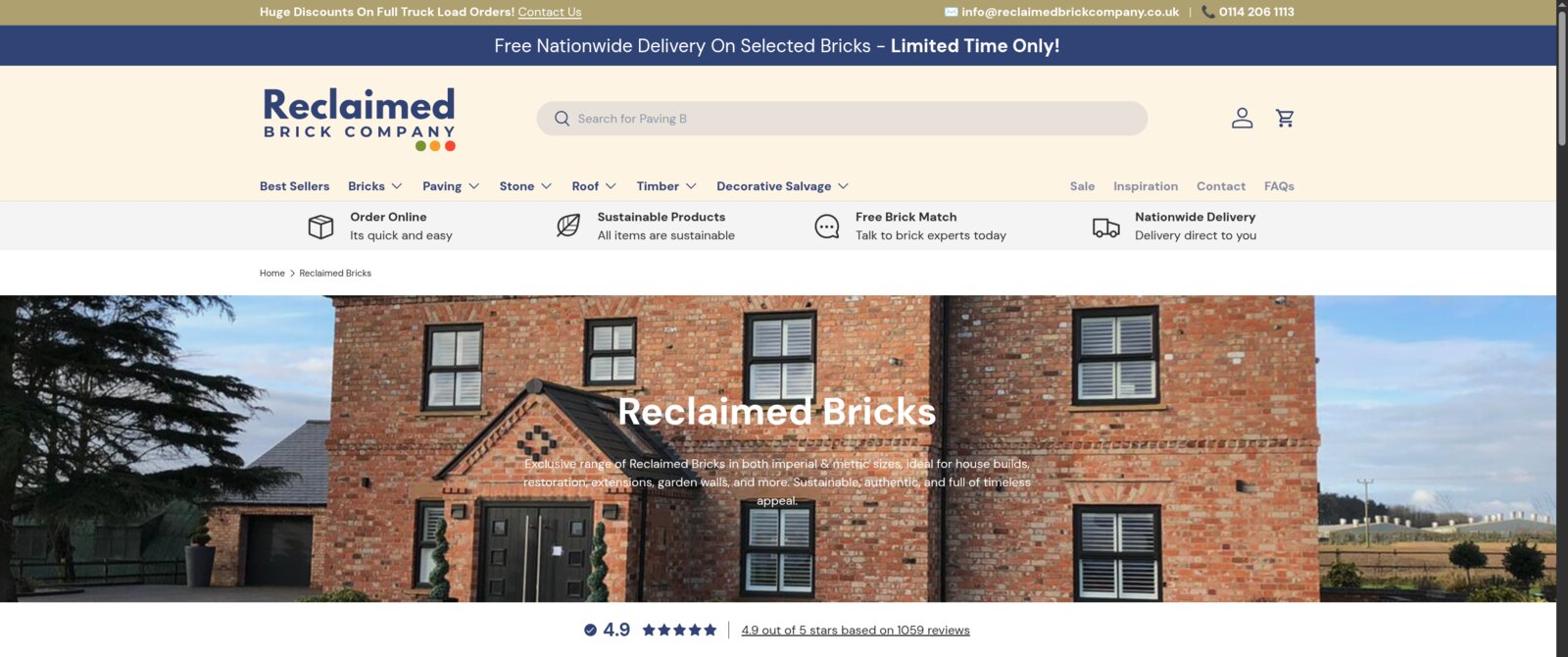
The Reclaimed Brick Company storefront, their own live Shopify homepage.
Their storefront today. Shopify.
  • Vintage Cameras

    2× visitors from Google

    4 months

    Read the write-up
  • Doncaster Van Centre

    9 years a client

    still current, August 2026

  • MortgagesRM

    9 years a client

    still current, August 2026

What it’s worth

You’re already paying for this — through the ad account.

When organic orders fall, the orders themselves don’t. You buy them back through Ads at a cost per order you didn’t have to pay two years ago, and it never shows up as a search problem because it shows up as a media line.

You stop buying back customers you already had
Every collection page that ranks again is a cohort you are no longer bidding for. That saving lands in your ad account rather than in ours, which is why it is the number we ask clients to watch.
You get an answer you can give the board
One figure, from your own GA4: orders and revenue from organic search, month on month, against what paid is costing to hold the same ground. Not a ranking report.
Orders you need either way Bought back through ads Organic orders
The shape of the argument, not one client's figures. The quantity that does not move is the orders you need either way.

Client reviews

4.8 on Google from 20 reviews. 4.2 on Trustpilot from 11.

Both scores, both counts, on two platforms we don’t control. The lower one stays on the page.

“SEO, what is that. After watching a video audit we knew what to do.”
Trustpilot review · summarised from the review, pending the exact wording

The second voice on this page is tenure rather than a testimonial: Doncaster Van Centre and MortgagesRM have both been clients for nine years, and both are current in August 2026.

How it runs

Sixteen weeks from a URL to a store that earns its traffic back.

Mapping a store’s old URLs against the new ones, week one of a recovery.
  1. Week 1

    Get the data

    • Read-only access to your GA4 and Search Console. Nothing that can change the store.
    • We crawl the whole store the way Google does and keep the result.
    • Your old URL list, if you moved platform. This is the one thing we may need you to dig out.
  2. Weeks 2–3

    Find the blockers

    • Every fault we can find, written so you can read it without us in the room.
    • Each one priced for us to fix it.
    • Ranked by what it is costing you, not by how hard it is to do.
  3. Weeks 3–14

    Fix the expensive ones

    • We build the fixes into your store ourselves. Nothing waits on your developer.
    • Nothing goes live until you have seen it and said yes.
    • The orders move in your own dashboard, which is where we report from.
  4. Week 16+

    Finish, then monthly

    • We tell you when the recovery is done. It has an end date from the first day.
    • Most clients carry on monthly: half new ground, half holding what you have.
    • One report in orders and revenue, and a call with whoever did the work.

Fit and price

Who this works for, and what it costs.

Who it works for

  • Stores doing roughly £500k a year and up. Under that, an agency retainer is the wrong thing to buy, and we will say so on the first call rather than after the first invoice.
  • It is not a fit if your category is too small for search to pay for itself, or if you need the numbers to move before a board meeting next month. Neither of those is a judgement about your store.
  • The monthly work is rolling. No notice period, no lock-in, reviewed every quarter — and at some of those reviews the honest recommendation is to stop paying us. We have made it.

What it costs

  • There is no price list, because there is no fixed price. A smaller store is less work and costs less, and a page that quoted you before anyone had opened your Search Console would be guessing.
  • What you get before any number exists: the full plan, in writing, and a conversation about it with the person who would actually do the work. You can stop there and you will not have paid us anything.
  • Every finding in that plan carries a price for us to fix that finding. Which means you can take the list to your own developer if they are cheaper — and some clients do.

Before you send it

Four questions people ask before they send us a URL.

How long before we see anything?
The redirects go in first and they move fastest, so Search Console usually starts showing recovered pages inside three to four weeks. The recovery itself runs eight to sixteen weeks, and which end of that you land on depends on what is underneath the drop rather than on how big your store is. Nothing visible happens in the first fortnight, because that fortnight is spent finding out what broke. Getting past where you were is a longer job again and it is measured in quarters.
Do you only work on Shopify?
Shopify and WooCommerce, and we are deliberately not adding a third. We rank both and we build both, which is the same knowledge used twice. It matters commercially too: when you ask whether you should move platform, we are the only people in the room with no reason to push you either way, because we get paid the same on both. We do take Magento, BigCommerce and custom-build work. We just don’t claim to specialise in it, and we’ll say so before you book anything.
What actually happens in month five, once the recovery is done?
Roughly half of it is new ground: the searches your category makes that you have no page for, written and built and linked properly. The rest is holding what you have. We read your release notes before they ship, so a theme update or a new app doesn’t quietly undo the redirects. You get one report, in orders and revenue from your own GA4, and a call with the person who did the work. If a month has nothing in it worth doing, we say so and bill you for less.
Is it a monthly retainer, and can we get out of it?
The recovery is a fixed term — eight to sixteen weeks, billed monthly, with an end date stated at the start — and when it is done we tell you it is done. Most clients carry on monthly from there, which is why our longest relationship is nine years old and still current. That monthly work is rolling, with no notice period and no lock-in, reviewed every quarter. At some of those reviews the honest recommendation is to stop paying us, and we’ve made it.

One URL, two working days

Send us the store. We’ll tell you what’s wrong with it.

No form to fill in, no call to book first, and nothing to pay if you take the findings away and fix them yourself.

  • David Johnson, Founder
  • Emma Morris, SEO specialist
  • Oliver Davies, SEO specialist
  • Evie Wiseman, SEO specialist
  • Manivannan M., SEO specialist

What arrives

  • A short video, five to ten minutes, recorded by David or Oliver rather than generated from a crawler.
  • Three to five findings, ranked by what each one is costing you, each with a price for us to fix it.
  • No pitch. If your SEO is fine, the video says so and that is the end of it.